Speak Like a Local
Stop Surviving in Hebrew. Start Living in It.
Speak Like a Local is a personalized 14-week 1-on-1 coaching program designed for Olim and internationals who are ready to stop freezing, bridge the gap between knowing Hebrew and actually speaking in daily life.
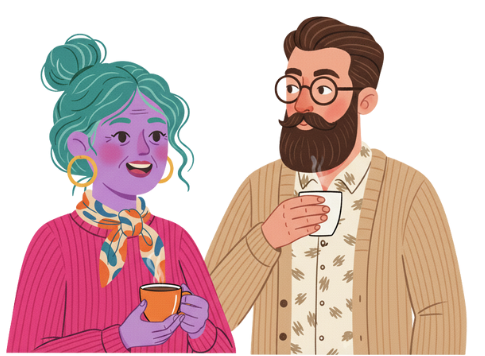
You know that moment?
You're standing in front of a shopkeeper, a neighbor, or a colleague. In your head, you're having a brilliant conversation - you're sharp, witty, and fully yourself. But the second you open your mouth, the words get stuck. Your sentences break, and within seconds, you find yourself switching to English just to escape the frustration.
It's exhausting to feel like a child again, needing basic help even though you're a capable, intelligent adult.
You've finished Ulpan, mastered the grammar, and understand almost everything happening around you.
But there's still a gap.
It's the panic you feel when a doctor speaks too fast, the helplessness of handling landlord issues, or that soul-crushing "Maaa?" look Israelis give you. In these moments, you just want to sound like the person you actually are.
"I finished Ulpan - why is speaking still so hard?"
It's a question I hear all the time: how is it possible to have lived in Israel for years, studied in Ulpan, and still struggle to speak - or find yourself switching to English right at the start of a conversation?
Ulpan gives you a solid foundation in reading, writing, and grammar. But "mouth-time" is divided among many students, and it’s easy to stay quiet and listen from the side.
The gap doesn't come from a lack of knowledge. It comes from a lack of real speaking time and the need to strengthen your speaking muscle.
The good news?
The gap isn't about knowledge. You already have more Hebrew than you think. What's missing is the muscle - the habit of actually using it out loud, in real situations, with someone who can guide you through the discomfort.
That's exactly what Speak Like a Local was built for.

About the Program
A personalized 1-on-1 coaching program with an native, experienced Hebrew teacher, designed to bridge the gap between the knowledge you have in Hebrew and active speaking. The program focuses on essential daily scenarios to help you gain the confidence to function independently and navigate Israeli life with ease.
That's what you'll learn:
- Navigating the supermarket, asking staff for items, and understanding sales
- Pharmacies & local shops: describing basic needs and handling returns
- Bonus: Navigating Israeli E-Commerce & Grocery Delivery Apps
- Public transport: buses, trains, Rav-Kav, and buying tickets
- Street smarts: asking for directions and navigating public spaces
- Bonus: Using Waze & Google Maps in Hebrew
- Essential communication with your landlord or neighbors
- Maintenance & repairs: explaining household issues to tradespeople
- Bonus: Understanding standard rental terms & utility bills
- Expressing symptoms, body parts, and how you feel
- Clinic (Kupat Holim) interactions: booking appointments and prescriptions
- Bonus: HMO/Health Apps & navigating phone menus
- Casual workplace talk: small talk with colleagues and coffee breaks
- Basic email/message etiquette and presenting your role clearly
- Bonus: Professional social media (LinkedIn) terms
- Everyday banking: ATM transactions, transfers, and card issues
- Dealing with local admin: post office, municipality (Arnona), and forms
- Bonus: Navigating Banking & Payment Apps (Bit / PayBox)
- Comprehensive review and consolidation of key frameworks
- End-to-end real-life simulations: handling a full day of mixed scenarios
- Bonus: Personal Vocabulary Bank & Next-Steps Roadmap
If any of these sound familiar —
this program is right for you.
Most people who understand Hebrew well feel a gap between what they understand and what actually comes out. This isn't about knowledge — it's about practice. In this program, we'll move your Hebrew from your head to your mouth, and train you to stay in Hebrew even without all the words — because that's the habit that actually improves spoken language.
The fear of sounding stupid or unintelligent when speaking a new language is very common. People who don't know you might think you're quiet or shy, when anyone who really knows you knows that's simply not true. And maybe you even think that about yourself — not necessarily because your Hebrew isn't good, but because in your mother tongue, or in your head, it sounds so much better. That's normal. Learning a new language takes time. It's an ongoing process in which you have to "start over" in some ways — and it takes patience. We have plenty of patience to let you experiment, make mistakes, and slowly become yourself in Hebrew.
In Ulpan, your speaking time is shared between many students. Sometimes it feels easier to let others take the floor and avoid the discomfort of making mistakes in front of everyone. With us, there's no escape — 100% of the time is yours. You'll speak at your own pace, make mistakes, and discover that there's no learning without them.
Anyone learning a new language is training their brain to handle something genuinely new — and yes, it really does feel like a workout sometimes. Just like in sport, the more you train, the easier it gets. We're here to help you build a consistent practice routine so that over time, Hebrew starts to feel lighter.
Bureaucracy, in any language, is stressful. Even native Hebrew speakers aren't fans. So it's even harder when it's not your mother tongue. In the program we'll learn relevant vocabulary, practice real situations, and go through the apps together, so that when the moment comes, you'll feel a little more prepared.
This is something every language learner goes through. Group conversations aren't just about language — they involve humor, cultural references, and current events that you absorb gradually, just like the language itself. There's no shortcut. But with consistent practice, you'll notice — looking back — that it's suddenly become easier.
Reading and speaking are two separate skills — practicing one doesn't necessarily improve the other. Text is static: you can process it at your own pace. A conversation is dynamic and fast, and requires a different set of skills entirely. That's exactly what we practice together.

If you want to close the gap between your
Knowledge to Speaking - you need to speak!
How it Works?
4 stages that take you from knowing Hebrew to actually using it.
Building your Vocabulary
Before each session, you'll receive focused video lessons to help you master the specific vocabulary you'll need, so that when we meet, we can go straight to speaking.
Time to Speak
In our private sessions, we create a space where mistakes are part of the process. We use real-life simulations to move the Hebrew from your head to your mouth, helping you practice again and again and build both your confidence and your ability.
Navigating Daily Scenarios
We dive into the essential areas of Israeli life — from healthcare and housing to career and bureaucracy. You'll practice the exact situations you're struggling with, so you can feel free to speak Hebrew.
Bringing It All Together
In the final stage, we connect all the dots. You'll learn to shift between topics and handle unexpected interactions, so that Hebrew starts to feel like a natural part of your day.
What Real Life sounds like?
I was living in Israel for many years when I started to study Hebrew privately with Noam. I was a waitress but couldn't speak freely in Hebrew. But speaking and working with Noam was comfortable and fun, and the classes were very interesting! I improved a lot. Of course, I still have work to do, but I'm proud of myself: I work for more than 6 months as a lawyer-assistant (in Hebrew!). Thank you Noam, you helped me a lot!
I was lucky to learn with Noam. She "forced" me to find the words and ignore my accent and my mistakes. I feel like I got over the hurdle of what really prevents people from learning Hebrew. I stopped panicking when people would speak to me and started to recognize words she taught us. Through expanding our vocabulary around specific scenarios I was able to master real life Hebrew situations!

If you actually want to speak Hebrew, learn with Noam. She keeps it fast, practical, and fun. Real conversations, laser-accurate corrections, and grammar explained like a human. You get culture, context, and confidence without the jargon.

I had been learning Hebrew with Noam for 1.5 years. Since I already had an intermediate level, I asked her to focus mainly on speaking, so our lessons were great friendly hangouts, where various topics were discussed related to everyday life, books, topics that I found difficult for me, because of a lack of vocabulary or topics that helped me learn more words related to my professional field and helped me in my career. She is a great teacher and a wonderful person who helps you not only improve your language skills but also grow as a person.
Bonuses!
The Hebrew Culture & Storytelling Library
Full access to three comprehensive digital study kits based on Israel's most beloved children's stories — with professional audio recordings, original texts, and practical exercises.
The Digital Independence Guides
Step-by-step tutorials for navigating essential Israeli apps — from booking doctor appointments to managing your bank account online, in Hebrew, without anxiety.
The "Keep Growing" Benefit
A special preferred rate on any additional private lessons you choose to take after completing the program — so you always have a clear path forward.
I am Noam
And Hebrew is my passion!
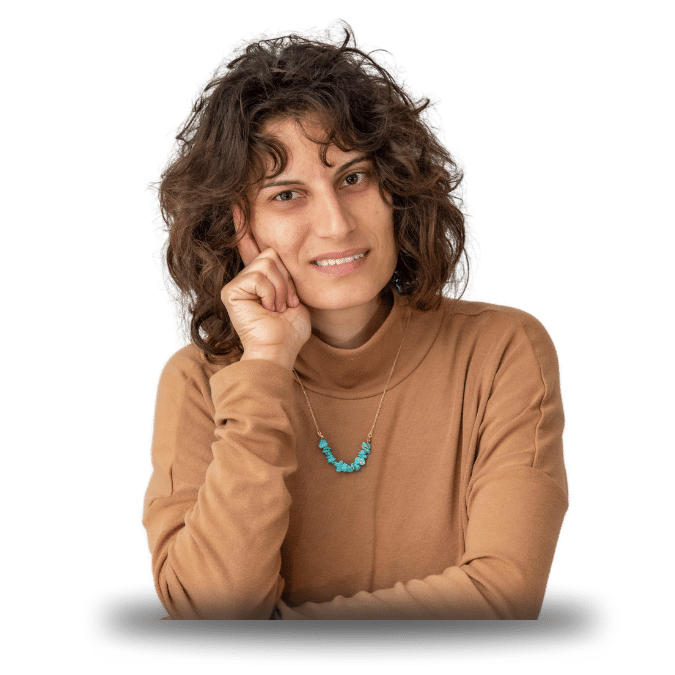
Hebrew is my native language, and teaching it is genuinely what I love to do.
Like most Israelis, I studied English for 8 years in school. I watched movies, played video games, and genuinely enjoyed learning. But if someone happened to speak to me in English, I wouldn't answer. I was convinced I didn't have the ability to speak, even though I understood everything.
It was only when I was "forced" to use English - because I joined a trip with a group of Americans during my military service - that something suddenly shifted, and all the English I had stored up moved into "speaking mode." I discovered that despite the fear, I could actually communicate pretty well. And my Israeli accent? That was a kind of bonus - it sounded cute (to them, at least).
For the last 7 years, I've been working with Olim, expats, and internationals who know Hebrew but struggle to actually speak it, helping them build their confidence.
After years of teaching at various Ulpans and working privately with hundreds of students, I've seen that the biggest barrier isn't vocabulary - it's self-criticism. My job is simply to help you silence that inner critic and find your voice in Hebrew.
Because to speak, you simply have to speak - even if it's not perfect.

FAQ
Ready to speak Hebrew like a Local?
Due to high demand, 1-on-1 spots are currently fully booked. Join the priority waitlist to get notified first as soon as a spot opens up for the next round.